 Shomari Deluccio
Most automation success stories come from companies with nine-figure technology budgets, dedicated data engineering teams, and the luxury of failed experiments that don't threaten the business.
That's not my story.
I built my automation systems inside small precision manufacturing shops – the kind that run on tight margins, lean headcount, and the expectation that you solve problems with what you have. No enterprise ERP with built-in AI modules. No IT department to call. No consultant telling me what the data meant.
Just years of watching the same patterns repeat, the discipline to document them, and eventually the tools to codify them into something that runs without me.
That last part is important. Because the real proof of concept isn't the system I'm building at work right now.
It's DelSpec Precision – the manufacturing company I founded 11 years ago, ran to $200K revenue per employee, added robotics to keep machines running with no one in the building, and have since automated so completely that it now operates as a side business while I run full operations elsewhere.
I am the product of my own methodology. And I'm just getting started applying it at scale.
The Philosophy: ZERO
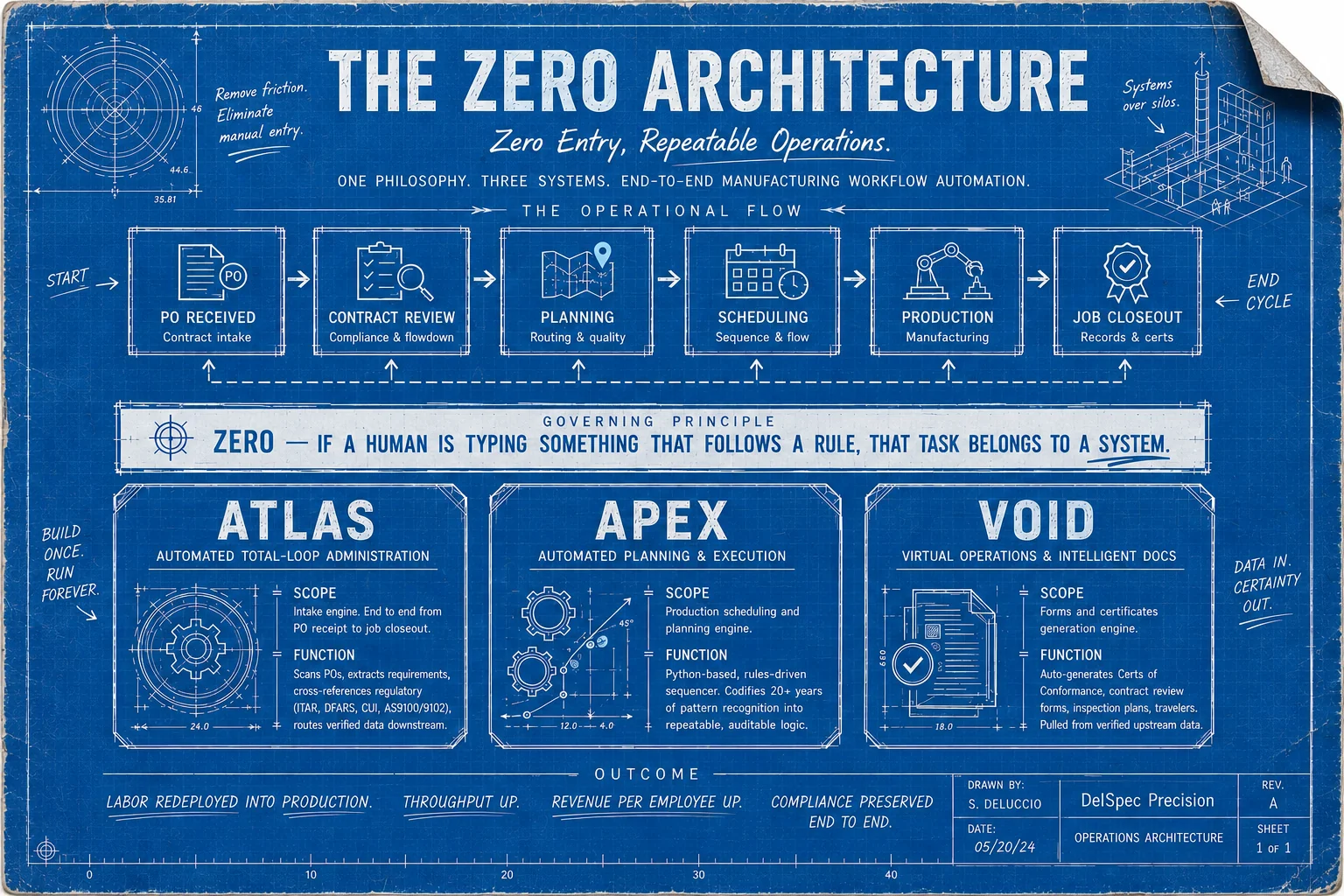
I operate under a principle I call ZERO – Zero Entry, Repeatable Operations.
It's my operational quality policy. The governing standard that every system I build is measured against:
If a human is typing something that follows a rule, that task belongs to a system.
Every repeatable event that gets typed can be automated. That single insight – developed over 20+ years of building systems from scratch across aerospace, defense, financial services, and manufacturing – is the thread running through everything I've built.
ZERO is not software. It's a design standard. And once you see operations through that lens, you can't unsee it.
The Insight That Stops Conversations
A few weeks ago I said something to my company president that stopped him mid-sentence:
"Every repeatable event that gets typed can be automated."
He didn't push back. He leaned in.
That sentence sounds simple. But it took 20 years to arrive at it with enough confidence to say it out loud – and a business I built from scratch to prove it was true.
Here's what it means in practice: in any manufacturing operation, there is a constant river of information flowing through the organization. Work orders, job travelers, scheduling updates, planning notes, contract reviews, purchase order receipts. In most shops, humans are the pipes. Someone types a job in. Someone else reads it and types a response. A planner reviews it and types a summary. A scheduler pulls it and types a sequence.
The same information, typed five different times by five different people.
Every keystroke is labor. Labor that isn't making chips, isn't turning a part, isn't shipping product to the customer. It's overhead wearing a production badge.
The question I couldn't stop asking: what if the rules governing all that typing are actually knowable?
Data Science First. Automation Second. Always.
Most people jump straight to automation. They buy a tool, configure a workflow, and wonder why it breaks six weeks later when reality doesn't match the template.
I took the opposite approach – because I couldn't afford to get it wrong.
I started with data science. Years of scheduling history, production records, job flow patterns, on-time delivery data. I looked for the rules hiding inside the outcomes. What sequences actually produced on-time delivery? What planning decisions consistently accelerated throughput? What patterns repeated so reliably that a human wasn't adding judgment – they were just executing a formula?
I tested those rules manually first. Ran them in parallel with existing processes. Validated them against real outcomes over time.
Only then did I write the code.
The result is APEX – Automated Planning & Execution System. A Python-based scheduling and planning engine built on rules that were proven before they were programmed. No black box. No algorithm I can't explain to a president, a customer, or an auditor. Just codified expertise – two decades of pattern recognition turned into repeatable, auditable logic.
This is exactly how DelSpec got to the point where it runs itself. I didn't automate first and ask questions later. I understood the operation deeply, documented the rules that governed it, validated those rules, and then removed myself from the equation step by step – eventually adding robotics so the machines kept running with no one in the building.
That sequencing is everything.
The Architecture: Working Backwards Through the Entire Operation
Here's where most operations leaders stop short – they automate one thing and call it a win.
I mapped the entire information chain:
Purchase Order Received Contract Review Planning Scheduling Production Job Closeout
Every stage involves repeatable typed events. Every stage is a candidate for automation. And every stage you eliminate pushes labor forward – toward the work that actually ships product.
APEX proved the model at the scheduling and planning layer. Now I'm building ATLAS – Automated Total-Loop Administration System – to handle the entire workflow from PO receipt to job closeout. ATLAS will scan incoming purchase orders, extract contract review requirements, cross-reference drawing requirements and regulatory obligations (ITAR, DFARS, CUI, AS9100/AS9102), and route verified information automatically to planning and quality – without a human re-typing any of it.
The forms and certificates that come out the other end – Certificates of Conformance, inspection plans, job travelers – will be handled by VOID: Virtual Operations & Intelligent Documentation. Auto-generated from verified upstream data. Audit-ready. Zero manual entry.
APEX, ATLAS, and VOID. Three systems. One philosophy: ZERO.
The end state: a purchase order enters at one end and a fully compliant, production-ready job packet comes out the other – with human judgment applied only where it genuinely changes the outcome.
This Is a Throughput Play. Not a Headcount Play.
I want to be direct, because this is where the conversation often goes wrong.
This is not about cutting people. It's about redeploying capacity.
Every hour freed from typing is an hour available for production. In a constrained manufacturing environment – and in aerospace and defense, every environment is constrained – the bottleneck usually isn't the machine. It's the human time wrapped around the machine: setup, documentation, coordination, data entry.
Free that time, and throughput goes up, revenue per employee goes up, and you've built a more competitive operation without adding headcount or capital equipment.
I proved this model at DelSpec. I'm proving it again now – in a more complex environment, with more variables, and with the benefit of knowing exactly how the story ends.
You Don't Need Fortune 500 Resources to Do This
If you're running a small or mid-size manufacturing operation, here's what I want you to hear:
The tools that built my systems cost less than a single month of overtime. What they required was time, rigor, and a willingness to understand your operation at a level most managers never go to.
The patterns in your data are there. The rules governing your scheduling, your planning, your contract review – they exist. They're just undocumented. They live in the heads of your best people, expressed every day in the decisions they make without thinking.
Your job, and mine, is to find those rules, validate them, write them down, and eventually hand them to a system that doesn't take sick days, doesn't lose context between shifts, and doesn't type the same thing five different ways.
Start where you have the most data. Test manually before you automate. Build on what's proven.
The leverage that comes out the other side is real. I've got 11 years, a self-running company, and a robotics system keeping machines running in an empty building to prove it.
That's ZERO in practice.
What's the one repeatable process in your operation that still depends entirely on someone typing it manually? Drop it in the comments.
Originally published on LinkedIn, June 4, 2026.